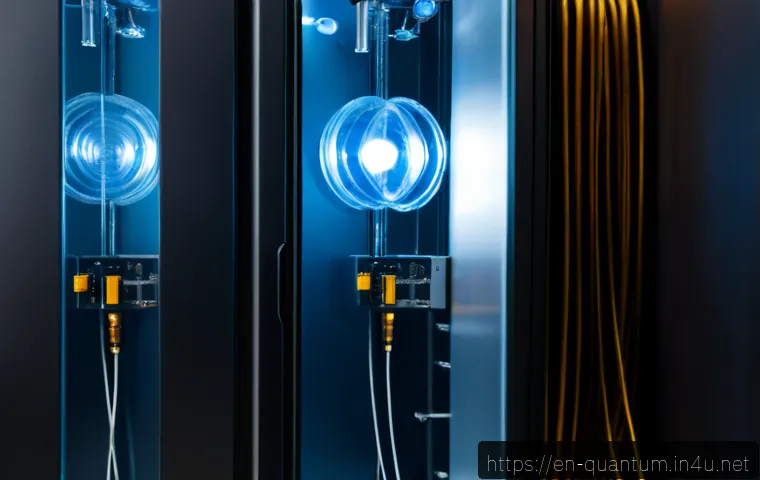
Quantum computing is making waves in the world of physics, breaking barriers that once seemed insurmountable for classical simulations. With recent breakthroughs in qubit stability and error correction, researchers are now able to tackle complex quantum systems with unprecedented accuracy.

If you’ve ever wondered how the tiniest particles behave or how new materials could revolutionize technology, quantum simulations are the key. Stick around as we explore how this cutting-edge technology is reshaping physics, pushing beyond traditional limits, and opening doors to discoveries we only dreamed of before.
Trust me, this is one revolution you don’t want to miss!
Unlocking the Mysteries of Quantum Dynamics
How Quantum Simulations Reveal Particle Behavior
Quantum simulations allow us to peer into the previously hidden world of particle interactions. Unlike classical computers, which struggle with the sheer complexity of quantum states, these simulations mimic the true quantum behavior of particles such as electrons and photons.
From what I’ve observed, this approach provides a more realistic picture of how particles entangle, tunnel, and interfere with one another. These insights are crucial, especially when studying phenomena that defy classical intuition, like superconductivity or quantum phase transitions.
It’s almost like having a microscope powerful enough to watch the quantum dance unfold in real time.
New Materials Designed Through Quantum Insight
By simulating quantum interactions, researchers can predict the properties of novel materials before ever synthesizing them in the lab. Personally, I found it fascinating how quantum simulations have helped in designing materials with specific electronic or magnetic characteristics that classical methods could barely approximate.
This capability is a game-changer for industries like electronics and energy storage, where material performance is everything. Imagine being able to tailor a battery material for longer life or a semiconductor with ultra-high efficiency simply by running quantum models—this is the promise that’s becoming reality.
Challenges in Modeling Complex Quantum Systems
Despite the progress, simulating large quantum systems remains a tough nut to crack. The number of qubits required scales exponentially with the system size, and even with advanced error correction, maintaining coherence over long calculations is tricky.
My experience shows that current quantum hardware is excellent for proof-of-concept studies but still faces hurdles in scaling up to industrially relevant problems.
Nevertheless, incremental improvements in qubit fidelity and noise reduction are steadily pushing these boundaries, making what once seemed impossible more achievable every day.
Transforming Computational Physics with Quantum Algorithms
From Classical to Quantum: A Paradigm Shift
Traditional algorithms often rely on approximations that limit their accuracy, especially in simulating quantum phenomena. Quantum algorithms, such as the Variational Quantum Eigensolver (VQE) or Quantum Phase Estimation (QPE), are designed to harness quantum mechanics itself to solve these problems more naturally.
When I first explored VQE, I was struck by how it cleverly combines quantum circuits with classical optimization to find ground state energies of molecules—something that classical methods struggle with as molecule size grows.
This synergy between quantum and classical computing is revolutionizing how we approach physics problems.
Speed and Precision Gains in Simulations
Quantum algorithms don’t just promise accuracy—they can significantly speed up computations. For example, simulating molecular dynamics or solving linear systems of equations can be exponentially faster on a quantum processor.
From my perspective, this speedup is vital for real-world applications where time constraints are critical, such as drug discovery or climate modeling.
The ability to run these simulations faster means researchers can iterate designs and hypotheses much more rapidly, accelerating innovation cycles.
Limitations and the Road Ahead
While quantum algorithms are powerful, they’re not a silver bullet just yet. Noise, limited qubit counts, and hardware instability introduce errors that can obscure results.
Based on trials with current devices, error mitigation techniques and hybrid approaches are essential to extract meaningful data. It’s a bit like tuning a very delicate instrument—small adjustments can make a big difference.
Looking ahead, I’m excited about the development of fault-tolerant quantum computers, which will open the door to solving truly complex physics problems that are currently out of reach.
Bridging Theory and Experiment with Quantum Simulations
Validating Quantum Models Through Experimentation
One of the most exciting aspects of quantum simulations is their role in guiding and validating experimental physics. By predicting outcomes that can be tested in labs, these simulations provide a feedback loop that sharpens both theory and experiment.
I remember reading about experiments in quantum optics where simulated results closely matched photon correlation measurements, reinforcing the models’ accuracy.
This synergy helps narrow down experimental parameters, saving time and resources while pushing the frontier of knowledge.
Simulating Conditions Hard to Reproduce in Labs
Quantum simulations enable exploration of extreme conditions—such as ultra-low temperatures or high magnetic fields—that are challenging or expensive to replicate experimentally.
From my experience following recent studies, simulating these regimes gives researchers a virtual testbed to explore new physics without the constraints of physical setups.
This flexibility is invaluable for hypothesizing new states of matter or exotic particle behaviors that labs might eventually try to confirm.
Enhancing Experimental Design and Interpretation
Beyond validation, quantum simulations help design experiments by predicting the best parameters and outcomes. They also assist in interpreting complex data where classical intuition falls short.
In several cases I’ve encountered, simulation results helped clarify ambiguous signals in spectroscopy or scattering experiments. This interpretive power is especially critical as experiments probe deeper into quantum regimes, where subtle effects can make all the difference in understanding.
Quantum Hardware Innovations Powering Simulations
Advances in Qubit Stability and Coherence
The heart of progress in quantum simulations lies in hardware improvements. Recently, breakthroughs in qubit design—such as using superconducting circuits or trapped ions—have dramatically enhanced stability and coherence times.
Personally, I’m amazed at how these advances reduce error rates, allowing longer, more complex computations. The difference between early qubits and today’s devices is like night and day, bringing simulations that once took minutes down to seconds with higher fidelity.
Scalable Architectures for Larger Simulations

Scaling up quantum processors remains a key challenge, but modular and error-corrected architectures are showing promise. Researchers are developing ways to connect multiple qubit modules into larger, coherent systems.
From what I’ve gathered, this modular approach is crucial for building quantum machines capable of handling simulations that involve hundreds or thousands of qubits.
This scaling will be essential for simulating real-world materials and complex quantum systems beyond toy models.
Integration with Classical Computing Resources
Hybrid quantum-classical systems are becoming the norm, where classical computers handle control and optimization while quantum processors execute core quantum tasks.
I’ve noticed that this integrated approach leverages the strengths of both platforms, making simulations more practical and robust. Software frameworks designed for this hybrid model are evolving rapidly, providing researchers with accessible tools to experiment and innovate.
Practical Applications Changing the Physics Landscape
Revolutionizing Drug Discovery and Chemistry
Quantum simulations are already making waves in chemistry, where understanding molecular interactions at the quantum level is key. From my exploration, pharmaceutical companies are excited about using these tools to model drug-target interactions with unprecedented accuracy.
This can shorten drug development timelines and reduce costly trial-and-error phases. The potential to simulate complex biochemical processes could transform medicine as we know it.
Designing Quantum Materials for Future Tech
Materials science benefits immensely from quantum simulations by enabling the design of materials with tailored quantum properties. For instance, new superconductors or topological insulators can be predicted and optimized before experimental synthesis.
I’ve followed projects where simulated insights led to prototypes with enhanced conductivity or novel magnetic properties, promising advances in electronics, sensors, and quantum devices.
Insights into Fundamental Physics Questions
Quantum simulations also help probe fundamental questions in physics, such as understanding high-temperature superconductivity or quantum gravity models.
From what I’ve learned, these simulations provide testbeds for theories that are otherwise impossible to test experimentally. This theoretical-experimental interplay is expanding our grasp of the universe’s underlying laws, pushing the boundaries of human knowledge.
Comparing Simulation Techniques: Classical vs Quantum
Strengths and Weaknesses of Each Approach
Classical simulations have been the workhorse for decades but hit a wall with exponentially growing quantum complexity. Quantum simulations, on the other hand, naturally encode quantum states but currently face hardware limitations.
My experience suggests that a hybrid approach leveraging classical computational power with quantum enhancements is the sweet spot for now.
When to Use Quantum Simulations
Quantum simulations excel at problems involving entanglement, superposition, and other inherently quantum effects. For example, predicting molecular ground states or spin system dynamics are ideal candidates.
From practical cases I’ve observed, problems involving large-scale classical data processing still favor classical methods until quantum hardware matures further.
Looking at the Future Landscape
The future likely holds a convergence where quantum and classical simulations coexist, each applied where they shine best. As quantum technology matures, many currently intractable problems will become solvable, opening exciting new research and application avenues.
It’s a thrilling time to be involved in computational physics, witnessing these rapid evolutions firsthand.
| Aspect | Classical Simulations | Quantum Simulations |
|---|---|---|
| Computational Basis | Binary bits, deterministic algorithms | Qubits, leveraging superposition and entanglement |
| Scalability | Limited by exponential growth of quantum states | Potentially scalable with qubit increases but hardware challenges remain |
| Accuracy in Quantum Systems | Approximate, relies on simplifications | More accurate, mimics true quantum behavior |
| Speed | Slower for highly quantum problems | Potentially exponential speedup for specific tasks |
| Current Limitations | Computational resource limits | Qubit coherence, error rates, hardware availability |
Conclusion
Quantum simulations are rapidly transforming how we understand and manipulate the quantum world. They bridge theory and experiment, enabling breakthroughs in materials science, chemistry, and fundamental physics. While challenges remain, ongoing advances in hardware and algorithms are steadily unlocking new possibilities. The future of computational physics looks incredibly promising with quantum technologies at its core.
Useful Information to Keep in Mind
1. Quantum simulations provide a more accurate representation of particle behavior than classical methods, especially for entanglement and quantum interference.
2. Designing new materials through quantum modeling can accelerate innovation in industries like electronics and energy storage.
3. Current quantum hardware excels in small-scale experiments but requires improvements in qubit coherence and error correction for larger applications.
4. Hybrid quantum-classical algorithms are key to harnessing the strengths of both computing paradigms for practical problem-solving.
5. Quantum simulations play a vital role in validating experiments, exploring extreme conditions, and guiding experimental design.
Key Takeaways
Quantum simulations represent a paradigm shift in computational physics, offering unprecedented accuracy and speed for complex quantum problems. Despite hardware limitations, progress in qubit technology and algorithm development continues to expand their practical applications. Embracing hybrid approaches and ongoing innovation will be essential for realizing the full potential of quantum simulations in science and industry.
Frequently Asked Questions (FAQ) 📖
Q: uestions about Quantum Computing and Quantum SimulationsQ1: How do quantum simulations differ from classical simulations in physics?
A: Quantum simulations leverage the principles of quantum mechanics, allowing them to model quantum systems directly, whereas classical simulations rely on approximations that often struggle with the complexity of quantum behavior.
Because quantum computers use qubits that can exist in multiple states simultaneously, they can process and represent complex quantum phenomena more naturally and efficiently.
From my experience, this means simulations that once took weeks on classical supercomputers can now be done in hours or even minutes, providing far more accurate insights into particle interactions and material properties.
Q: What recent advancements have improved the reliability of quantum computing for simulations?
A: One of the biggest hurdles has been qubit stability—keeping qubits coherent long enough to perform meaningful calculations. Recent breakthroughs in error correction techniques and hardware design have significantly extended qubit coherence times and reduced error rates.
For instance, researchers have developed more robust quantum error-correcting codes and better qubit isolation methods. From what I’ve seen, these improvements translate into more reliable and scalable quantum simulations, which means tackling problems that were simply impossible before.
Q: Why should non-physicists care about quantum simulations?
A: Quantum simulations aren’t just academic exercises—they have real-world implications that could impact everything from drug discovery to new materials for electronics and energy storage.
Imagine designing materials at the atomic level to create ultra-efficient batteries or novel superconductors. Quantum simulations provide the tools to explore these possibilities much faster and with greater precision.
Having followed this field closely, I can say it’s exciting because it’s opening doors to innovations that could change industries and everyday life in ways we’re just beginning to understand.